Strictly speaking, the term “glutathione deficiency” refers to a deficiency of reduced glutathione (GSH) within the cells. The most common reason for such a GSH deficiency is free radicals or oxidative and nitrosative stress, for example due to
- environmental influences of all kinds (insecticides, biocides, exhaust fumes, electrosmog, heavy metals …)
- suboptimal nutrition (vitamin deficiency, alcohol consumption …)
- side effects of (vitally) necessary medical therapies (harmful breakdown products of medicines, side effects of radiotherapy or chemotherapy …)
In addition, free radicals are also produced as a metabolic product during normal, healthy cell respiration.
What is oxidative stress?
If the body is suffering from oxidative stress, this means that too many ROS (reactive oxygen species) are present in the organism. These are free radicals that contain an oxygen compound. These molecules are also called oxygen radicals for short. They cause great damage in the body because they damage other molecules, for example cell membranes or genes.
Oxygen radicals can damage virtually all cell structures throughout the body.
What is nitrosative stress?
Nitrosative stress is likewise caused by free radicals, except that the molecules concerned contain nitrogen compounds rather than oxygen compounds. These are also referred to as reactive nitrogen species (RNS). Just like ROS, these radicals damage a wide variety of the body's molecules.
RNS, too, can damage a wide variety of structures in the organism.
In defending itself, the body “uses up” GSH
To ward off free radicals and compensate for the damage they cause in the organism, the body's own reduced glutathione is used up: it oxidises to GSSG (oxidised glutathione).
The oxidised glutathione should then actually be regenerated and returned to the active form GSH. But the quantity of radicals is often so great that a great deal of reduced glutathione is used up. In this case, too much oxidised glutathione remains after detoxification. The “recycling mechanisms” are overwhelmed.
This impairs the ratio of GSH to GSSG, which should normally be 400 : 1.
ATP: the most important energy carrier
The glutathione system is of great importance for a person's energy level. Various mechanisms play a role in this. They are all connected with the substance ATP (adenosine triphosphate), which is also called the “energy currency of the body”. ATP is produced in the cells, more precisely in the mitochondria, the “power plants of the cell”.
Every person uses up roughly the weight of half their body mass in ATP every day and forms the same quantity anew. Under heavy strain, ATP turnover can be as much as 500 g per minute.
Glutathione needs ATP and vice versa
Free radicals are produced when ATP is made: the more energy is produced, the more free radicals are generated. These must be “defused” by the body's own reduced glutathione so that they do not cause damage. At the same time, the production and “recycling” of glutathione also consume energy in the form of ATP.
If the glutathione system gets out of balance for any reason and, as a result, less reduced glutathione is available, a vicious circle can therefore easily develop: less GSH means reduced protection against free radicals. The free radicals damage the mitochondria, in which ATP energy is produced. ATP synthesis is impaired as a result, and less energy is available. This in turn results in lower glutathione production.
Under these circumstances, the glutathione system can no longer adequately perform its crucial health functions.
The main problem: weakness, tiredness, exhaustion
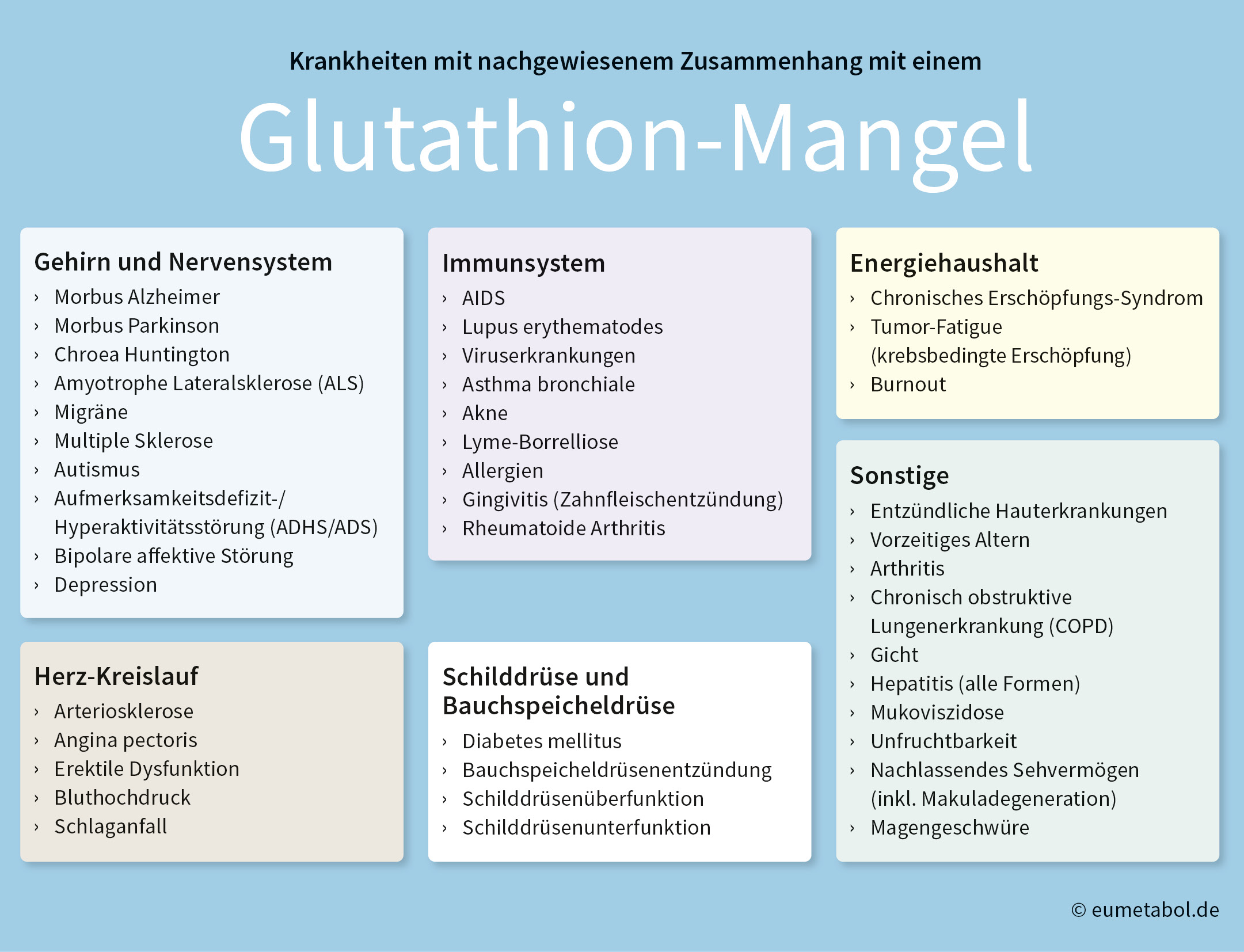
If the glutathione system gets out of balance, antioxidant defence is no longer assured. Cell metabolism and the immune system are also considerably impaired. A wide range of health problems can result.
One of the most serious consequences is the general and profound energy deficit that can arise from a glutathione deficiency. The reason for the weakness is that, without enough reduced glutathione in the cells, the mitochondria can no longer produce sufficient ATP. Chronic exhaustion syndrome, tumour fatigue and burnout syndrome are all connected with this.
The level of reduced glutathione within the cells is decisive for the energy level.
Glutathione deficiency and the immune system
Glutathione plays a decisive part in the proper functioning of the immune system. Numerous studies with various viruses have shown that glutathione has immunomodulatory and antiviral effects. The different interlocking mechanisms involved are now well researched:
- Glutathione regulates the oxidative state within the cells. This disrupts the entry of various virus strains into the body's cells, and infections are inhibited.
- High intracellular glutathione levels prevent viruses from multiplying in the body. The viral concentration, which largely determines the severity of a disease, remains lower.
- Glutathione supports the so-called TH1/TH2 balance. This is the basis for the body reacting appropriately to viral and bacterial or parasitic “attacks”. In this way, glutathione ensures an appropriate and effective immune response.
- Glutathione is important for the processing of antigens, i.e. foreign proteins that have entered the body. The response of important immune cells (APC) to the presented antigens is also partly determined by glutathione.
- In viral infections and many other diseases, the intracellular glutathione level falls. Oxygen radicals are generated that can cause lasting damage to the cells. Eumetabol® prevents this damage by effectively raising intracellular glutathione levels. In doing so, it also prevents possible secondary damage from viral and other infections.
The connections are so relevant and well documented that doctors interpret a person's lowered glutathione level as an indication that the person concerned has an increased risk of diseases of the immune system: glutathione is regarded as one of the most important prognostic markers for almost all immune diseases.
Conversely, a healthy intracellular glutathione level ensures that the body's own defence system remains efficient and effective. In post-viral syndrome in particular (persistent exhaustion, joint pain, muscle pain and headaches, anosmia or smell disorders, dizziness, etc.), a sustained increase in the intracellular glutathione level can provide relief.
Further consequences of a glutathione deficiency
If glutathione values are lowered or the ratio of reduced to oxidised glutathione has become unbalanced, the glutathione system can no longer perform crucial tasks. The following problems then frequently occur:
- increased oxidative stress, recognisable e.g. from elevated values of certain markers in the blood, such as isoprostanes or NF-κB
- damage to the DNA (the carrier of genetic information) caused by increased oxidative stress due to free oxygen radicals
- impaired function of the “cellular power plants” (mitochondria) as energy producers
- increased risk of diseases such as fatigue, fibromyalgia, candidiasis (fungal infection), HIV/AIDS, herpes simplex, Lyme borreliosis, etc., which are associated with mitochondrial dysfunction
- tendency towards inflammatory reactions, recognisable e.g. from elevated blood values of certain markers such as TNF-α
- increased risk from heavy metals such as lead, aluminium, cadmium, chromium, mercury, etc., because toxic heavy metal deposits can no longer be sufficiently eliminated and excreted by glutathione
- development of diseases and complaints that are caused or partly caused by increased heavy metal exposure, e.g. allergies, asthma, fibromyalgia, nerve diseases, fungal diseases, chronic tiredness, fatigue, hyperactivity …
- immune deficiency and weakened defences, since glutathione is important for the healthy functioning of the immune system
Important: a glutathione deficiency with all its possible consequences can only be treated by effectively increasing the intracellular glutathione level with S-acetyl-glutathione.